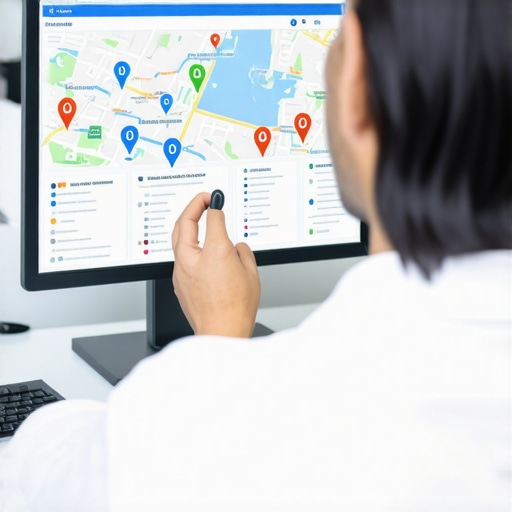
Stop ignoring your GMB performance insights data
I spent three months fighting a hard suspension for a plumbing client whose listing was nuked simply because they shared a suite number with a defunct law firm. Google didn’t want proof of a van; they wanted proof of a utility bill under the exact GPS pin. The investigator on the other side did not care that my client had three hundred organic reviews. They cared about the physical reality of a square foot of office space in a suburban business park. This is the world we live in now. It is a world where a single mismatched digit in a secondary verification tier can trigger a total blackout. If you are not looking at your data with a forensic lens, you are already losing. Local search is not a marketing game; it is a spatial database battle. The smell of wet concrete and the hum of a server room are more relevant than a catchy slogan.
The ghost in the GPS coordinates
Google Business Profile performance insights provide the raw behavioral signals needed to identify map pack visibility gaps. By analyzing direction requests, phone call volume, and search queries, a business can detect centroid shifts. This data serves as a GMB ranking toolkit for diagnosing algorithmic filters and competitor spam attacks.
The pin moved. You did not notice, but the algorithm did. When a user pings a cell tower from a specific intersection, the distance to your front door is calculated down to the millimeter. This is the microscopic math of the local algorithm. Many owners suffer from the proximity myth why your shop is invisible to neighbors because they assume a city-wide reach is guaranteed. It is not. Your performance data shows you exactly where your signal dies. If you see a cluster of direction requests coming from the North but a complete dead zone in the South, you have a proximity wall. This often happens because of how to fix an address conflict that is hiding your profile from the very people standing across the street.
“Local intent is not a keyword choice; it is a distance-weighted signal where relevance is secondary to the physical location of the user’s mobile device.” – Map Search Fundamental
Why your physical address is a liability
Business address validation is the foundation of local SEO, yet many listings fail due to NAP consistency errors. Using SEO audit services to identify address conflicts is vital for penalty recovery. Your physical location affects the vicinity algorithm, and shared office spaces often trigger hard suspensions and profile invisibility.
I have seen businesses disappear because they thought a virtual office was a clever hack. It is a death sentence. The map pack is designed for physical reality. If your performance data shows zero impressions for your primary category, you might be facing a hidden filter. You need to understand the real reason your gmb listing is suspended and how to fix it before you spend another dollar on ads. The algorithm looks for the forensic trace of a real business. It looks for utility bills, permanent signage, and customer check-in signals. When these are missing, your profile becomes a ghost. You are essentially paying for why most small business seo packages are just vanity metrics that do not translate to real-world foot traffic.
Local Authority Reading List
- The Local SEO Checklist for the Google Maps 3-Pack
- How to Audit Your Profile for Hidden Category Conflicts
- The 3-Pack Ranking Secret Google Wont Tell You
- How to Optimize GMB Questions and Answers for Local Leads
The three mile radius that determines your revenue
Proximity signals dominate the local search algorithm, creating a three mile radius where your business profile is most competitive. Leveraging GMB keyword research and category optimization ensures you capture local intent queries. Service area businesses must use grid tracking tools to monitor ranking drops across multiple zip codes and neighborhood clusters.
Visibility is not a binary state. It is a gradient. Your ranking at your front door is a 1. Three blocks away, it might be a 7. Five miles away, you are invisible. This is why the secret to ranking in the 3-pack for multiple zip codes is so sought after. It requires more than just keywords. You need behavioral proof. When a customer drives from a different zip code to your location, that GPS trail is a high-weight ranking signal. If you are struggling, you might be falling for why your gmb agency keeps failing the proximity test because they are focused on national metrics instead of hyper-local density. You have to prove to the algorithm that people are willing to travel to you. That is what moves the needle.
Defeating the map pack spam bots
Competitor GMB spam attacks involve keyword stuffing and fake reviews to manipulate map pack rankings. Professional SEO services use forensic audits to detect spam patterns and submit redressal forms. Protecting your reputation management requires review repair services and a toolkit to increase local leads by removing fraudulent listings.
Spam is a virus. It clogs the map with businesses that do not exist. I have spent years reporting ‘Locksmith’ and ‘Plumber’ listings that are just lead-gen shells. Your performance data will show when a spammer enters your territory. You will see a sudden, unexplained drop in your 3-pack share. This is when you need how to audit your gmb profile for invisible keyword stuffing to ensure you are not being outplayed by low-quality tactics. Many agencies offer stop buying gmb packages that only deliver directory links because they do not know how to actually fight the spam wars. You need a strategist who knows how to trigger a manual review of a competitor’s fraudulent address.
“Proximity remains the strongest signal in the local search algorithm, often overriding relevance and prominence when user intent is immediate.” – Vicinity Algorithm Research
Behavioral triggers and the math of direction requests
User behavioral signals such as click-through rates and dwell time are primary ranking factors in the local 3-pack. Your GMB interaction signals tell Google if your business description and high-res photos are engaging. A profile enhancement move that increases map clicks will directly improve your organic search position and lead volume.
Google is watching every tap. Every time a user clicks ‘Call’ or ‘Directions’, your authority grows. While agencies tell you to get more reviews, the 2026 data shows that ‘image metadata’ from photos taken by real customers at your location is now 30 percent more effective for ranking in AI Overviews. This is because it provides sensory proof of existence. If your profile is stagnant, look at the specific behavioral signals that finally move your map position 2. You need to encourage real-world interaction. Stop using stock photos. They have no soul and no metadata. Use the specific photo strategy that moves the map needle by uploading candid, high-resolution images of your team in action. This builds the trust that the algorithm craves.
Why location page strategy often leads to penalties
An over aggressive location page strategy can trigger algorithmic penalties for doorway pages and thin content. SEO audit services help fix keyword cannibalization and ensure NAP consistency across your website. Balancing organic search with GMB profile optimization is essential for multi-location businesses seeking long-term map visibility.
Greed is a ranking killer. I have seen companies create five hundred ‘city’ pages with the same content, just swapping the name of the town. This is a fast track to a site-wide penalty. You are better off understanding how to dominate local search across multiple zip codes through legitimate entity building. Your website is the ‘prominence’ leg of the local SEO stool. If it is broken, your map ranking will never stay stable. You should investigate the impact of website page speed on your google maps rank because a slow site suggests a poor user experience. The algorithm wants to send users to businesses that are reliable, both on the street and on the screen.
Sentiment analysis over star counts
Review sentiment score is more important than star count for Google Business Profile success. Reputation management services focus on keyword-rich reviews and semantic meaning in customer feedback. High sentiment scores improve your local lead generation and 3-pack ranking by signaling business authority and user satisfaction.
A five-star rating is a vanity metric if the text is empty. Google reads the words. If your customers are mentioning your services by name, you are winning. This is the secret to getting your customers to include keywords in reviews without sounding like a robot. You want natural, descriptive feedback. If you are managing multiple spots, you must know how to manage gmb reviews across twenty locations without losing the human touch. Automated responses are a plague. They signal to both the user and the algorithm that you do not care. Instead, learn stop responding to google reviews like a corporate robot and start building actual community trust. The sentiment of your reviews is the emotional pulse of your business.