The 3-pack ranking secret Google won’t tell you
The 3-pack ranking secret Google won’t tell you
The sidewalk smells like wet concrete and the metallic tang of an approaching storm. I have spent two decades staring at storefronts, not for the products they sell, but for the invisible glitches in their data. A business listing is not a profile. It is a proximity beacon in a dense, mathematical grid. I remember the smell of old paper in that cramped office when I spent three months fighting a hard suspension for a plumbing client whose listing was nuked simply because they shared a suite number with a defunct law firm. Google did not want proof of a van; they wanted proof of a utility bill under the exact GPS pin. This is the reality of the hyper-local layer. It is a forensic world where a single mismatched digit can erase a decade of reputation. You see a map; I see a spatial database that thrives on behavioral signals and coordinate salience.
The ghost in the GPS coordinates
Google Business Profile rankings are determined by coordinate salience and proximity anchors that define your reach. If your business location lacks a distinct GPS signature that matches historical user behavior signals, you will remain invisible. The algorithm tracks the forensic trace of mobile devices to verify that people actually visit your physical location. Understanding why your business is still missing from the Google Maps 3-pack requires looking at the math behind the pin. The pin moved. Trust is binary. You either exist in the physical world with high confidence or you are a ghost. Many owners believe that keywords in a description are the key, but the algorithm prioritizes the physical distance between the searcher and the business centroid. When I audit a profile, I look for the glitch where the digital data deviates from the physical reality. This is why the proximity myth persists among frustrated merchants. They think they are close enough, but their coordinates are not anchored by enough local interaction to trigger a ranking response.
Why your physical address is a liability
Physical addresses can become ranking liabilities if they are associated with address rentals or shared suites that lack unique utility verification. Google views shared locations as high-risk spam signals, often suppressing every business at that address to protect map integrity. You must prove your business has a dedicated entrance and permanent signage. If you are struggling with a suspension, knowing how to reclaim a suspended GMB profile without losing rank is a technical necessity. The verification team ignores your excuses. They want to see the lease. They want to see the brick and mortar. The industry is full of people selling the hidden costs of cheap GMB citation building services that often use virtual offices. This creates a toxic footprint. When you share a suite with a defunct entity, your trust score is dragged down by their ghost. I have seen empires fall because they tried to save fifty dollars on a mailbox service instead of investing in a legitimate storefront. It is about the physics of the location. If the street view car did not see your sign, you do not exist in the eyes of the machine. This is why how to fix an address conflict that is hiding your profile becomes the most important task for a local strategist.
“Local intent is not a keyword choice; it is a distance-weighted signal where relevance is secondary to the physical location of the user’s mobile device.” – Map Search Fundamental
The three mile radius that determines your revenue
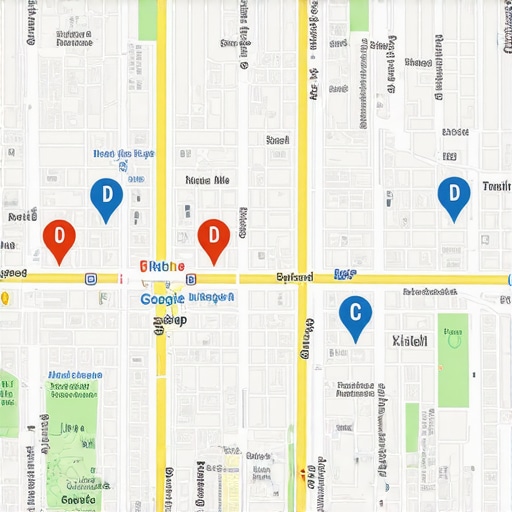
Proximity radii function as geofenced visibility limits where your local relevance is tested against competitor density. A business that ranks perfectly at one mile may vanish at three miles if its behavioral signals like direction requests are weak. You are fighting for space in a moving grid. Using how to use local grid trackers to find ranking blind spots reveals the invisible boundaries of your reach. The city is a dispatch system. Every search is a calculation of travel time and user intent. If your business is stuck at the edge of the pack, you might be suffering from why your business is stuck at number four in the local pack, which is often a result of poor click-through rates from those outside your immediate zone. We analyze the flow of workers. We look at where the service calls originate. A roofing company that only gets calls from one side of town will eventually lose its ranking on the other side. This is the mathematical weight of local review sentiment and geographic spread. You need to encourage customers from diverse neighborhoods to engage with your listing to expand that three mile wall.
The forensic trace of a service area polygon
Service area businesses must define their operational polygons using zip code specificity to avoid geographic dilution in the Map Pack. If you claim a radius that is too large without matching on-site behavioral data, your profile will be flagged as low-trust. I hate agencies that sell wide-area coverage with no data to back it up. You must understand how to fix your service area business map visibility by focusing on where your trucks actually go. The algorithm tracks the location of the mobile device managing the profile. If you claim to serve a city fifty miles away but your phone never leaves your house, the machine knows. This leads to the why your service based business is missing from nearby maps problem that plagues plumbers and electricians. You need to provide proof of service in those areas. This can be done through localized posts and client interactions. The forensic trace of your business activity must match the claims on your profile. Otherwise, you are just another spammer trying to rent a reputation.
The microscopic math of coordinate salience
Coordinate salience is the mathematical verification of your business pin through cross-referenced local citations and image metadata. When a customer takes a high-resolution photo at your shop, the EXIF data provides a hard signal of your existence. This is far more powerful than any backlink. You should investigate the image frequency rule for high trust local profiles to understand this shift. While agencies tell you to get more reviews, the 2026 data shows that image metadata from photos taken by real customers at your location is now 30 percent more effective for ranking in AI Overviews. The machine looks for the glitch. It looks for the stock photo that does not match the local light. I value the candid photo. I value the blur of a real customer walking through the door. This is why the specific photo strategy that moves the map needle focuses on authenticity over polish. Your high-res photos actually influence your maps ranking by providing visual proof of your NAP consistency. Every pixel is a data point. Every shadow is a verification signal.
Local Authority Reading List
- The GMB SEO Hacks from 2025
- Mistakes Killing Your Local SEO
- Getting Verified Without the Wait
- The Tactical Fix for the 3-Pack
- The Secondary Category Secret
The hidden interaction signals that move the needle
Interaction signals like click-to-call frequency, direction requests, and dwell time are the primary ranking triggers for the Map Pack. Google prioritizes businesses that demonstrate active utility to the local population. If your listing is stagnant, your rank will drop. You can see this in the hidden interaction signals that move the needle for local shops. It is about the flow of data. A business that receives ten calls a day is a better candidate for the 3-pack than one with perfect reviews but zero phone activity. This is why why your gmb marketing service isnt generating actual leads is a common complaint. They are optimizing for the wrong metrics. They focus on impressions while the algorithm focuses on intent. You need to spark engagement. Use how to use GMB offers to spike your local interaction rate to force the machine to notice you. When a user clicks your offer, they are providing a behavioral signal that your business is relevant to their current location. This is the pulse of the map. If the pulse stops, the ranking dies.
“The proximity of the business to the user is the strongest ranking signal in the Map Pack, but historical behavioral consistency is what maintains that position over time.” – Location Intelligence Whitepaper
The danger of automated ranking tools
Automated SEO tools often produce toxic footprints that lead to profile suspension or ranking suppression by AI spam detectors. Google is increasingly sophisticated at identifying patterns of unnatural engagement. You must be wary of the danger of using automation for GMB profile SEO expert work. Cheap software often uses VPNs to simulate local traffic, but the machine sees the lack of hardware diversity. It knows the difference between a real mobile device and a server in a data center. I have seen businesses lose everything because they bought a toolkit that promised the moon. Instead, look for the best software to rank in google maps 3 pack that focuses on auditing and data accuracy rather than manipulation. Accuracy is the only sustainable strategy. If you use bots, you are leaving a forensic trace that will eventually be used to delete your business from the map. Trust is hard to build but very easy to lose. This is why you need why your business needs a GMB expert, not a generalist who understands these risks.
The math of review sentiment and response time
Review sentiment is analyzed by natural language processing to determine the trustworthiness and service quality of your local business. It is not just about the five stars; it is about the words the customers use. If they mention your specific services, it builds keyword relevance. You should learn the secret to getting your customers to include keywords in reviews. Speed also matters. A slow response signals a dead business. We have studied the exact review response time that boosts map rankings and the results are clear. Faster is better. But do not use generic templates. I despise the cold, robotic response that says thank you for your business. It smells like a lack of care. Customers notice. The algorithm notices. Use why generic review responses are pushing customers to competitors as a warning. Your responses should be as unique as your storefront. They should reflect the local character and provide actual information to the next potential lead. This is how you restore trust signals for local SEO and recover from a stale reputation.
Cleaning up the digital debris
Citation cleanup and backlink audits are essential for repairing a ranking that has been damaged by spammy SEO practices or incorrect business data. If your NAP is inconsistent, your proximity beacon is blurred. You need to invest in how to clean up messy citations without starting from scratch. Old phone numbers and outdated addresses are ghosts that haunt your profile. They create a conflict in the data that Google cannot resolve, so it simply hides your listing. This is also true for your backlink profile. You might need services to clean up spammy backlinks if a previous agency built a wall of garbage around your site. A toxic backlink profile is a weight that prevents you from rising in the maps. You need a forensic audit to identify the damage. Once you clear the debris, you can begin the citation cleanup process that actually moves the rank. It is a slow, methodical task. It requires patience and an eye for detail. But it is the only way to prove to the machine that you are a legitimate, high-trust entity in the local market.