The Fix for Local Businesses Hidden by Address Conflicts
The invisible digital wall blocking your local customers
I stand on the corner of 5th and Main, the smell of wet concrete rising from the sidewalk after a summer rain. I am not here for the view. I am here because the digital map says there is a locksmith in that brick building, but my eyes see a vacant lot. I am a street photographer of the digital world, noticing the glitch in the storefront data where others see only a loading screen. Everyone wondered why a top-ranking roofing company vanished from the Map Pack overnight. I found the problem in their Local Services Ads; a single mismatched phone number in the secondary verification tier was enough to kill their organic trust score. They had fallen victim to a centroid collapse, a phenomenon where Google loses faith in the physical legitimacy of a business because the data points stop pointing to the same coordinate. This is the reality of the modern local algorithm. It is not about keywords or links. It is about the math of GPS coordinate salience. When you deal with services to fix mismatched business address and phone number, you are not just editing a profile. You are performing surgery on a spatial database that values truth over marketing. This guide examines how a toolkit to rank higher in local map pack functions and why your physical address is often your greatest liability.
Why your physical address is a liability
Address conflicts occur when the Google Business Profile database identifies multiple entities at a single point or finds conflicting NAP data across the ecosystem. This creates a trust deficit that suppresses your ranking in the 3-pack. If you have ever wondered how to fix the your business is not visible to customers error, the answer usually lies in the underlying citation fabric. Google cross-references your listed address with utility bills, secretary of state records, and third-party directories. When these sources disagree, the algorithm defaults to the most conservative move; it hides you. This is why why automated citation building often does more harm than good because it creates a messy trail of inconsistent data that triggers a manual review. I have seen businesses get nuked because they used a suite number that once belonged to a different industry. The algorithm sees two categories at one door and assumes one is a ghost.
“Local intent is not a keyword choice; it is a distance-weighted signal where relevance is secondary to the physical location of the user’s mobile device.” – Map Search Fundamental
The ghost in the GPS coordinates
Proximity math relies on the latitude and longitude coordinates of the user’s mobile device compared to the verified pin of the business profile. If your pin is even ten feet off the actual entrance, you lose relevance for the hyper-local user. Most how gmb ranking toolkits work for local seo ignore the micro-movement of the pin. They focus on broad city-level data while ignoring the fact that a user on the next block is getting a different result than the user across the street. You must understand the proximity myth how to rank in maps from two towns away to realize that you cannot simply buy your way into a new zip code without a physical anchor. The behavioral signals of users walking toward your shop are tracked. If Google sees people searching for you and then turning around because the GPS lead them to a back alley, your rank will tank. This is the forensic trace of a service area polygon in action.
Forensic audit of the local map pack
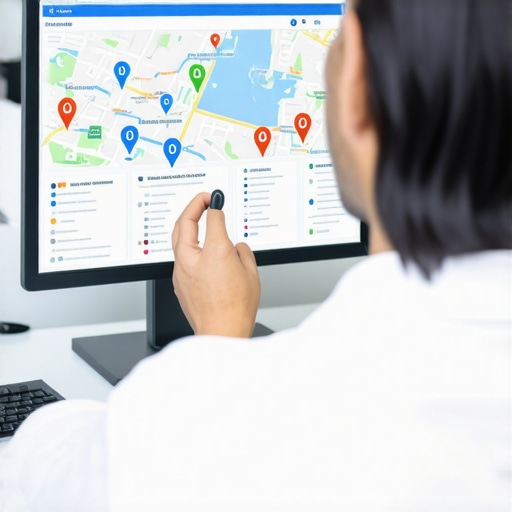
A toolkit to rank higher in local map pack must include data validation and competitor proximity analysis features. You cannot rely on a single dashboard. You need to see the grid. Using a how to use local grid trackers to see your real search visibility allows you to identify where the address conflict is actually happening. Is it a global suppression or a local overlap? When I perform the first move a gmb profile seo expert makes during a crisis audit, I look for duplicate listings. These are the silent killers. If you have a duplicate, Google splits your authority. It is like having two different people trying to answer the same phone call. Neither gets the message.
Local Authority Reading List
- Evaluation Checklist for SEO Packages
- Identifying Toxic Citation Profiles
- Why Ranking Services Fail to Generate Calls
- Behavioral Moves for Authority
Cleaning up the black hat footprints
Seo services to clean legacy black hat local seo footprints are essential for businesses that have previously used keyword stuffing or virtual offices. The algorithm has a long memory. If you once used a P.O. Box or a shared workspace without a dedicated entrance, that footprint remains. You need seo services to remove google manual action if your profile has been flagged for deceptive practices. This involves a total scrub of the internet. You must find every mention of the old address and the old phone number. This is why how to clean up messy citations without starting from scratch is the most valuable skill in a local strategist’s arsenal. It is tedious, manual work that software cannot replicate perfectly. You are cleaning the digital lens so Google can see your business clearly again.
The three mile radius that determines your revenue
Local service area bidding and proximity engineering define the success of a business within a specific geographic circle. Beyond three miles, your organic visibility drops significantly unless your brand authority is massive. To counter this, you need to understand the secret to ranking your business in multiple nearby zip codes through localized content and behavioral signals. Google looks for real-world interactions. They look for direction requests. They look for phone calls that originate from the map. If you are how to improve google business profile ranking toolkit, you are looking for ways to trigger these signals. It is not just about the address; it is about the traffic flowing to that address. When I see a business stuck at number four, I look at the the tactical fix for businesses stuck at number four in the map pack which often involves increasing the frequency of customer-uploaded photos. These photos contain metadata that proves existence in a way that text never can.
The primary category secret for dominating results
Selecting the correct primary category is the single most important decision in your local seo strategy. A single mistake here can hide you from 80 percent of your target audience. I once saw a plumber who had their primary category set as ‘Drainage Service’ instead of ‘Plumber’. They were invisible for the most high-volume searches. You should study the primary category choice that determines 80 percent of your rank before you make any changes. Address conflicts are often exacerbated by category conflicts. If your website says one thing and your GBP says another, the algorithm gets confused. This is why you need how to sync your website data with gmb for better local authority. The data must be a mirror image. Any distortion in that mirror leads to a ranking drop.
“The proximity of the business to the user is a primary ranking factor in the local algorithm, but the consistency of the NAP data is the foundation upon which that proximity is measured.” – Location Intelligence Whitepaper
Removing the manual action anchor
Seo services to recover from google penalty require a deep audit of your backlink profile and your citation network. If you have been hit with a manual action, it is usually because of ‘spammy behavior’ in the eyes of a human reviewer. This could be anything from faking reviews to using a residential address for a retail business. You need to use a local seo checklist and toolkit for gmb to identify where the violation occurred. Most people try to hide the evidence. I recommend a different approach. Be transparent. Fix the address. Show the utility bill. Rebuild the trust. I have seen how we recovered a map ranking that was stuck for six months by simply removing a dozen low-quality directory listings that were pointing to a defunct office. The pin moved. The calls started coming in again. The smell of victory is much better than the smell of wet concrete on a failed job site.