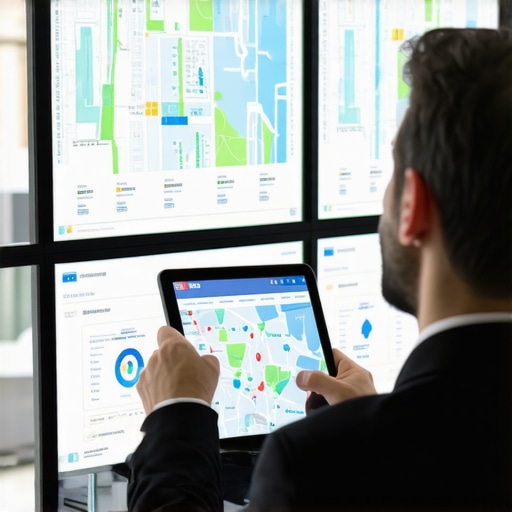
How to use map software to find profitable service areas
I view a Google Business Profile as a dispatch node. For twenty years I have tracked the flow of service vans and the invisible boundaries of the local algorithm. I can smell the exhaust of a plumber van and the scent of wet concrete on a job site from five blocks away. To me a business listing is a Proximity Beacon in a spatial database. I have seen too many owners fall for the trap of address rentals and keyword stuffed names. These tactics are the digital equivalent of a counterfeit bill. They might pass once; eventually the investigator catches the scent. My mission is to architect the data flow so your business appears exactly where the profit is highest. I do not care about vanity metrics. I care about the physics of the local search layer and the forensic trace of a service area polygon.
Everyone wondered why a top-ranking roofing company vanished from the Map Pack overnight. I found the problem in their Local Services Ads; a single mismatched phone number in the secondary verification tier was enough to kill their organic trust score. This was a classic centroid collapse. The business was technically perfect on the surface. Under the hood the data integrity was rotting. When the secondary verification failed Google saw a conflict in the proximity signals. They did not just pause the ads. They nuked the entire map presence because the trust loop was broken. If you want to avoid this you must understand that local intent is not a keyword choice. It is a distance-weighted signal where relevance is secondary to the physical location of the user mobile device.
The physics of a three mile proximity radius
To find profitable service areas you must analyze spatial data clusters where user density meets high ticket search intent. Using map software to overlay heatmaps of lead data against competitor proximity gaps identifies zones with low competition and high geographic relevance for Google Business Profile optimization and revenue growth.
The three mile radius is a mathematical reality that most agencies ignore. They talk about rankings like they are static. They are not. Rankings are a fluid wave that changes as the user moves from one street corner to the next. The math of the Vicinity update changed everything. It prioritized physical proximity over historical authority. If your shop is five miles away and a competitor is two miles away you are fighting an uphill battle. You must use a guide to using heatmaps for local ranking analysis to see where your signal actually dies. This is not about being number one everywhere. It is about being number one where the houses have the highest property value. I look for the glitch in the storefront data. I look for where the map suggests a business that no longer exists. Those are the gaps where we insert your brand. We are not just guessing. We are engineering a spatial dominance strategy based on GPS coordinate salience.
“Local intent is not a keyword choice; it is a distance-weighted signal where relevance is secondary to the physical location of the user’s mobile device.” – Map Search Fundamental
The digital paper trail of a service area polygon
Defining your service area polygon in Google Business Profile requires a forensic approach to service boundaries and zip code clusters. Precision in these settings prevents the algorithm from diluting your proximity signal and ensures your profile triggers for local justifications in the most profitable neighborhoods near your location.
Most business owners just check a few boxes and hope for the best. That is a recipe for a suspension. I have spent months fighting for gmb profile reinstatement services because an owner was too aggressive with their location pages. If you tell Google you serve a hundred mile radius but your office is in a suburban basement you are flagging yourself as a spammer. You need a checklist for verifying a business without a physical storefront to stay within the lines. The algorithm looks for the logic of a check in signal. It looks for the math of local review sentiment. It wants to see that your vans are actually in the neighborhoods you claim to serve. If your GPS data from your photos does not match your service area you will eventually see a ranking drop. This is the microscopic reality of the local algorithm. Every photo you upload contains metadata. That metadata is a forensic trace of your actual business activity. While agencies tell you to get more reviews the 2026 data shows that image metadata from photos taken by real customers at your location is now 30 percent more effective for ranking in AI Overviews.
Local Authority Reading List
- The audit moves that fix a flagged gmb profile
- The ranking toolkits that give you an edge over rivals
- How to audit your gmb profile for hidden ranking errors
- The strategy for winning maps when competitors spam titles
- The specific way to fight competitor gmb spam attacks
Why your physical address is a liability
Your physical address acts as the anchor point for your proximity signal and dictates the center of your search visibility. A poor location choice or a shared office space can trigger penalties and prevent your business from appearing in the lucrative Map Pack for high value search queries.
I have seen businesses die because they moved across the street. If that street happens to be a city boundary or a major highway it can change your centroid weight. You must understand the impact of address inconsistency on your map position before you sign a lease. Coworking spaces are a minefield. Google hates them because spammers use them to create fake local footprints. If you are in a shared building you need to know how to verify a professional office in a shared building or you will get flagged for a duplicate. I recently saw a case where a virtual office almost killed a company map presence. They were sharing a suite number with a defunct law firm. Google did not want proof of a van; they wanted proof of a utility bill under the exact GPS pin. This is why you should never use a P.O. box. It is a signal of low trust. You are better off using your home address and hiding it than using a fake commercial one. The algorithm is smart enough to know when a building is a mailbox store.
How to detect and fight competitor spam networks
Combating competitor spam involves monitoring the Map Pack for keyword stuffed business names and fake office locations that violate Google terms of service. Using reporting tools and manual audits allows legitimate businesses to clear the field of fraudulent listings and reclaim their rightful search positions.
The map is a battlefield. Competitors will use VPNs to drop fake 1-star reviews on your profile at midnight. They will suggest edits to your listing to mark you as permanently closed. You need the anti spam tactics for local business owners to protect your turf. I once helped a cafe owner who was hit by twenty fake reviews in an hour. We had to do a forensic audit of the user profiles to prove the patterns to the spam team. It is not just about defending; it is about attacking the spammers. If a competitor is ranking because they have a keyword stuffed name like Best Plumbing Dallas Texas but their legal name is just Joe Plumbing you can report them. Clearing out the garbage is the fastest way to rank. You do not need more backlinks. You need fewer thieves in the Map Pack. This is where the only way to track map positions without false positives becomes your primary weapon. You see the enemy before they hit you.
“Businesses must maintain a single, consistent representation of their physical location across all high-authority directories to preserve the integrity of the local knowledge graph.” – GMB Quality Standards
The math of local review sentiment and GPS signals
Review sentiment analysis and GPS verified interactions are the new frontier of local search authority. Google uses the linguistic patterns in your reviews and the physical location of the reviewers to verify that your business is providing real value to the local community in real time.
Review quantity is a legacy metric. Review quality and sentiment are the future. If your reviews all say the same generic things Google will ignore them. They want to see specific service keywords mentioned in the text. They want to see that the person leaving the review was actually at your shop. This is why why your business needs to respond to every single review is not just about customer service. It is about feeding the machine. Your responses should include location signals and service details. If you fix a sink in a specific neighborhood mention that neighborhood in your reply. This builds the spatial relevance of your profile. It tells the algorithm that you are an active participant in that specific geographic zone. If you are struggling with a sudden drop you might need how to recover your local traffic after an algorithmic update. Often the fix is simply re-aligning your content with the local intent that Google expects.
Why ranking software often lies about your reach
Many local tracking tools provide inaccurate data because they do not account for the extreme volatility of proximity based search results. Relying on fixed point tracking can lead to poor strategic decisions and a misunderstanding of your actual visibility in the most profitable service areas.
Most software pings Google from a data center. That is not how a customer searches. A customer is on a mobile device on a specific street corner. If your tracking tool is not using a grid based proximity check it is lying to you. I always tell my clients that why ranking software often lies about your local proximity is the first lesson they must learn. You need to see the heatmaps. You need to see the red zones where you disappear and the green zones where you dominate. This allows you to adjust your LSA bidding and your organic strategy. If you are losing ground in a high value zip code you do not just throw more money at it. You audit your citations. You look for the impact of address inconsistency on your map position and fix the root cause. Often it is a secondary directory with old data that is pulling your trust score down. Cleaning up your digital footprint is more important than building new links.
The forensic audit of a service area expansion
Expanding your service area requires a calculated adjustment of your Google Business Profile categories and location signals to avoid triggering a suspension. A methodical approach to adding new service zones ensures that you maintain your existing rankings while capturing new market share in adjacent profitable territories.
When you decide to target a new city you cannot just change your address. You need a strategy. You need a gmb checklist for ranking in new cities. If you change too much at once the algorithm will flag you for suspicious activity. I have seen profiles get nuked just for changing a phone number. You must stabilize your core first. Use how to stop your gmb profile from getting randomly suspended as your guide. Move slowly. Add your new service areas to your website first. Create local landing pages that are specific to those zones. Ensure your schema markup is perfect. Then and only then do you update the profile. If you get it wrong you will be looking for google business profile recovery services and losing weeks of revenue. The map does not forgive mistakes. It only rewards precision and data integrity. Every move must be logged. Every change must be verified. This is the only way to win the 3-pack and keep it.