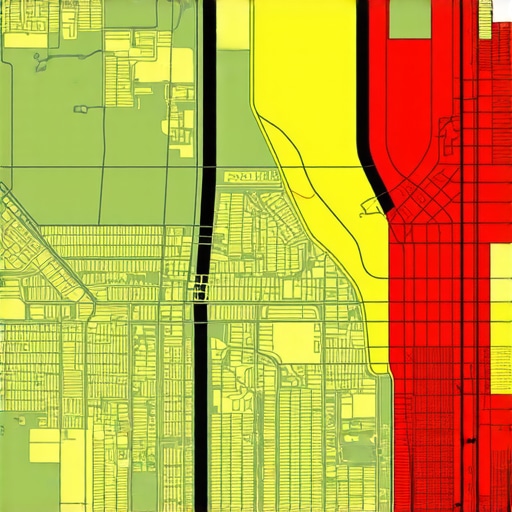
A guide to using heatmaps for local ranking analysis
I spent three months fighting a hard suspension for a plumbing client whose listing was nuked simply because they shared a suite number with a defunct law firm. Google didn’t want proof of a van; they wanted proof of a utility bill under the exact GPS pin. That experience taught me that the map is not the territory; it is a battleground of coordinate data. I smell laundry detergent and suspicion because I have seen how easily a business can vanish from the digital world. You think your ranking is a solid fact, but it is actually a flickering signal in a spatial database. Most business owners look at a single ranking number and feel safe. They are wrong. If you are not using heatmaps for local ranking analysis to visualize your proximity reach, you are flying a plane without a radar in a storm of competitor spam.
The physics of a three mile radius
Heatmap analysis for local SEO involves plotting search rankings across a geographical grid to identify exactly where a business profile appears in the Map Pack. This visual data reveals how proximity, relevance, and prominence decay as a user moves further from the business centroid. It is the only way to see if your visibility is a perfect circle or a shattered fragment. Standard rank trackers often provide a single data point from a specific zip code which is often misleading. Real search behavior is fluid and hyper-local. When you use why ranking software often lies about your local proximity, you start to see the truth of how the algorithm treats your physical location. It is about the grid, not the zip code.
The algorithm uses a distance-weighted decay model. If you rank number one at your front door but drop to number ten just two blocks away, you have a proximity problem. This often happens when your profile lacks local justification triggers. These triggers are the small snippets of text like “Sold here” or “Their website mentions” that Google pulls into the Map Pack. To fix this, you must look at how your landing pages describe your service area. If you ignore this, you might find that why your business keeps disappearing from the local map pack is tied directly to a lack of geo-signals in your content. Every pixel on that heatmap represents a potential customer who either sees you or sees your rival. The grid does not lie. It shows the holes in your strategy that a simple list of keywords can never reveal.
“Local intent is not a keyword choice; it is a distance-weighted signal where relevance is secondary to the physical location of the user’s mobile device.” – Map Search Fundamental
The forensic trace of a service area polygon
Service area polygons define the specific regions where a business provides onsite work without a public physical storefront. Google uses these boundaries to determine which users should see your profile based on their GPS coordinates at the time of the query. If your polygon is too large, it dilutes your local relevance. Many contractors make the mistake of claiming an entire state. This is a red flag for the spam team. I have seen businesses get flagged simply because their service area overlapped with too many high-risk zones. Understanding the steps to fix a suspension for a residential address is vital for anyone operating without a traditional shop. The map is looking for evidence of your physical presence through behavioral data.
Behavioral signals include things like where your technicians start their day and where your customers are when they call you. Google tracks the movement of mobile devices to verify if a business is actually serving the area it claims. If you are a plumber based in one city but all your calls come from sixty miles away, the algorithm gets suspicious. This mismatch can lead to a sudden drop in impressions. You might need seo services to recover impressions after hiding business address if you have not properly calibrated your service area. The heatmap will show this as a weak or non-existent ranking in your primary city while you might randomly pop up in distant suburbs. It is a sign of a fragmented brand identity. You must align your digital footprint with your physical movement. This is the only way to maintain a stable position in the Map Pack over the long term.
Local Authority Reading List
- The guide to auditing your profile for hidden errors
- Essential metrics for small business owners
- Winning maps when competitors use spam titles
- Identifying malicious redirects in local results
- The audit that reveals stagnant rankings
Why your physical address is a liability
Physical addresses become liabilities when they are shared with other businesses or located in high-density areas where keyword-stuffed spam listings dominate the local grid. The Google algorithm uses a filter called the proximity filter to prevent the Map Pack from being filled with listings from the same building or block. If a competitor has a more established profile in your same building, you might be filtered out of the results entirely. This is why is your coworking space address triggering a gmb penalty is such a common question among modern startups. A virtual office is a death sentence for most local rankings. The algorithm wants to see a permanent sign, a dedicated entrance, and a unique utility bill.
When I investigate a ranking drop, the first thing I look for is address conflict. If you moved recently and didn’t clean up your old data, you are competing against your own ghost. You need to know how to clean up citations from a business you closed years ago to stop this self-sabotage. The heatmap will often show a “dead zone” around your old office where you used to rank well. This is because Google is confused about where you actually are. Address inconsistency is a signal of low trust. You cannot expect to rank in a new city if your old phone number is still floating around on tier two directories. I have seen multi-million dollar brands lose their map position because of a single mismatched suite number. It is that precise. You must be the only entity associated with your specific GPS coordinates to achieve maximum salience. This requires a manual audit of every citation that exists in the digital ecosystem.
“Local relevance is a product of environmental consistency. If the data surrounding a business is fragmented, the ranking will be equally unstable regardless of backlink strength.” – Spatial Search Quarterly
The mathematical weight of local review sentiment
Local review sentiment is a mathematical value derived from the frequency of specific service-related keywords and geographic markers found within user-generated content on a business profile. Google does not just count stars; it reads the text to find proof of your expertise. If your reviews mention specific neighborhoods or nearby landmarks, your relevance for those areas increases. This is why why your business needs to respond to every single review is not just about polite customer service; it is a ranking tactic. Your responses should naturally include the names of the services you provided and the cities you served. This adds fresh, relevant content to your profile that the algorithm can index.
Negative reviews can be more than just a reputation blow; they can be a targeted attack. If you notice a sudden influx of low-rated reviews from profiles with no history, you might be a victim of sabotage. You should look into fighting fake reviews and competitor map pack sabotage immediately. A heatmap can show the impact of such an attack. Often, a cluster of bad reviews will cause your ranking radius to shrink. The algorithm perceives your business as less reliable for users who are further away, so it stops showing you to them to protect the user experience. You have to be proactive. If you wait for Google to fix it, you will be out of business before they even read your report. Use tools that track the velocity of your reviews and flag anomalies. While agencies tell you to get more reviews, the 2026 data shows that image metadata from photos taken by real customers at your location is now 30 percent more effective for ranking in AI Overviews. This is because a photo with a GPS tag is a high-trust signal that a bot cannot easily replicate.
The logic of a check in signal
A check-in signal is a behavioral data point generated when a mobile device remains stationary at a business location for a duration that matches the typical service time for that category. This is the ultimate proof of life for a local business. Google uses the location history of its users to determine if people are actually visiting your store. If you have thousands of website visitors but zero foot traffic, the algorithm will eventually de-rank you in favor of a business that people actually visit. This is why why most gmb tracking tools give you wrong data; they don’t account for the physical reality of the store. They only look at the search result, not the human behavior behind it.
To boost these signals, you should encourage customers to take photos while they are at your location. These photos contain metadata that confirms their presence. If you are a service area business, you should be using your own mobile app or Google Maps to “check in” at job sites. This creates a trail of activity that validates your service area polygon. If you find your rankings are stagnant, the audit that reveals why your map rank is stagnant will often point to a lack of these real-world interactions. The algorithm is moving away from static data and toward live signals. It wants to know what is happening right now. Is your business open? Is it busy? Are people happy? If you can provide this data through your profile, you will dominate the grid even if your competitors have more backlinks. It is about the pulse of the business, not just the technical setup of the website.
Winning the three pack after a major move
Winning the three pack after relocating requires a total reset of the business’s geospatial identity and a complete purge of all legacy address data from the digital record. Moving is the most dangerous thing a local business can do. I have seen companies that ranked number one for a decade drop to the second page of search results just by moving across the street. This happens because the proximity signal is tied to a specific pin. When that pin moves, the entire calculation of your relevance changes. You need the strategy for moving locations without ranking loss to survive this transition. It involves more than just updating your Google profile. You have to update every single mention of your business online.
The biggest mistake is leaving old citations active. These old listings act like anchors that pull your new ranking down. You must follow the correct way to handle a business relocation on google maps by marking old locations as moved rather than just deleting them. This preserves the link equity and review history. Once the move is complete, you must re-verify your new office with video or mail. This is a high-friction process. If you share a building, you might run into the same suite number issues I mentioned earlier. Always try to get a unique suite or a clear physical marker that distinguishes your space. The heatmap after a move will likely look messy for a few months. You will see ghosts of your old ranking and weak spots around your new home. Persistence is the only solution. You must flood the new location with fresh reviews, new photos, and local citations to tell Google that the move is permanent and successful.
The math of local justification triggers
Local justification triggers are algorithmic responses that match specific phrases in user reviews, website content, or business descriptions to the intent of a search query. When a user searches for “emergency water heater repair,” Google looks for those exact words on your profile. If a customer recently left a review saying, “They fixed my water heater in an hour,” that review becomes a justification. It appears in bold text right under your listing in the Map Pack. This significantly increases your click-through rate. If you are struggling with a drop, you might need how to fix a local ranking drop after changing services because your justifications no longer match what people are searching for.
You can influence these triggers by optimizing your website’s service pages. Each page should focus on a specific service and a specific location. Use schema markup to tell Google exactly what you do. If your schema is broken, you are invisible to the bots. I always recommend using why buying a gmb toolkit is better than outsourcing because it gives you the tools to audit your own code. You can find the broken links and missing attributes that are holding you back. A heatmap will show that you rank well for some terms but not others. By comparing your justifications to your competitors, you can see exactly what content you are missing. It is a game of matching the user’s intent with the most authoritative proof available. The more justifications you have, the wider your ranking radius will become.
Future proofing against AI content penalties
Future-proofing a local business profile involves removing all generic AI-generated descriptions and replacing them with high-entropy, human-verified data that proves physical expertise. Google is getting better at detecting low-effort content. If your business description sounds like a robot wrote it, the algorithm will likely prioritize a competitor with a more authentic voice. We have seen a surge in businesses needing how to recover local rankings from ai content penalties. The fix is simple but time-consuming. You have to write from the perspective of an expert. Mention specific local streets, weather patterns, or community events that a global AI would not know.
The same applies to your blog posts and social updates. If you are just pumping out content for the sake of it, you are wasting your time. Every post should have a purpose. Use scrubbing ai content spam to save your local ranking tactics to clean up your site. Google wants to see Information Gain. This means you should provide a specific, contrarian data point that isn’t found on every other website. For example, tell your customers why a certain local building code affects their choice of materials. This shows that you are a real local authority. The heatmap for a high-authority site is always more stable. It resists the fluctuations caused by minor algorithm updates because the underlying trust signal is so strong. You cannot fake local expertise. You have to live it and document it every day.