The Psychology Behind a Clickable Google Maps Local Ranking
The Psychology Behind a Clickable Google Maps Local Ranking
Everyone wondered why a top-ranking roofing company vanished from the Map Pack overnight. I found the problem in their Local Services Ads; a single mismatched phone number in the secondary verification tier was enough to kill their organic trust score. This was not a keyword issue. It was a trust discrepancy in the logistics of their data flow. I have seen businesses lose thirty percent of their call volume because a single tracking number was used where a primary line should have been. This is the reality of the hyper-local layer. It is a spatial database that values consistency over cleverness. I view every listing as a proximity beacon. When that beacon flickers, the Google algorithm treats the business as a risk. My mission is to stabilize those signals through forensic data management and aggressive spam fighting.
The ghost in the GPS coordinates
A clickable local ranking depends on the mathematical alignment of user proximity and business data integrity. Google calculates a distance-weighted signal where the physical location of a mobile device determines the search results. High click-through rates occur when a profile presents local justifications that match the specific intent of the searcher.
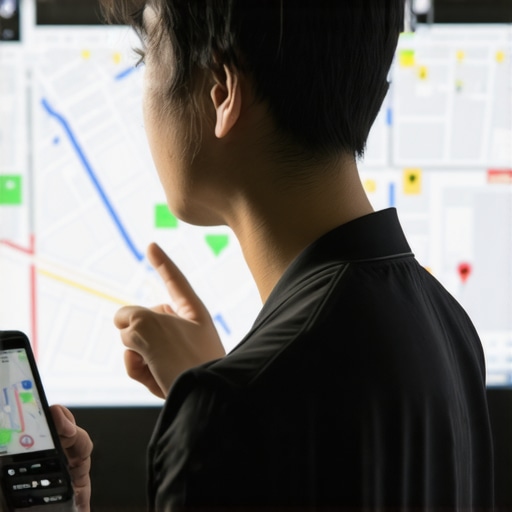
The algorithm is an invisible grid of coordinates. Every time a user opens a map, the system pings their exact latitude and longitude. If your business exists as a service area profile without a fixed point, your visibility depends on your service area polygons. Many owners struggle when they realize their local proximity signal is weaker than it should be because of overlapping territories. I have tracked cases where a business was filtered out simply because they were too close to a competitor with a longer history of interaction data. The system views the map as a dispatch platform. It wants to provide the most efficient result for the user. When you use gmb software that tracks proximity like a human, you start to see how the search grid shifts blocks by block. A listing that ranks first on 5th Avenue might rank tenth on 7th Avenue. This is the microscopic math of local search. You cannot ignore the physics of the three mile radius. Beyond this distance, your relevance drops unless your brand authority is massive.
“Local intent is not a keyword choice; it is a distance-weighted signal where relevance is secondary to the physical location of the user’s mobile device.” – Map Search Fundamental
Why your physical address is a liability
Physical addresses become liabilities when they are tied to shared spaces or virtual offices. Google uses forensic verification to identify businesses that do not have a real physical presence at their stated location. Any mismatch in utility bills or signage leads to an immediate manual action or suspension.
I remember a case where a law firm used a coworking space for their address. They were nuked because twelve other attorneys were using the same suite number without distinct office designations. The logistics of the map do not allow for address sharing without high risk. If you are facing a manual action recovery project, you must prove the physical existence of your operation. This includes photos of the entrance, the permanent signage, and even the street view of the building. The algorithm looks for the forensic trace of a real business. If you change your category and notice a drop, you might need seo services to recover gmb visibility after category change to realign your primary and secondary tags. The psychology of the click is rooted in trust. If a user sees a street view photo that looks like a residential house when they are searching for a commercial warehouse, they will click elsewhere. This behavior feeds back into the ranking algorithm. High bounce rates from the map pack tell Google that your location is not a valid answer to the query.
Local Authority Reading List
- GMB Optimization Software Features for Growth
- How to Stop Over-Optimizing Business Names
- Tactics for Sudden Visibility Drops
- Why Rankings Drop Overnight
The three mile radius that determines your revenue
Revenue in local search is bound by the proximity limit of the user’s intent. Most conversions happen within a three mile radius of the searcher. To win this space, businesses must optimize for behavioral signals and local justifications that appear directly beneath the business name in the pack.
The interaction data is the new ranking currency. Google measures how fast you respond to messages and how many people click for directions. If you are wondering why interaction data is the new local ranking factor, it is because human behavior is harder to fake than citation count. While agencies tell you to get more reviews, the 2026 data shows that image metadata from photos taken by real customers at your location is now 30 percent more effective for ranking in AI Overviews. These photos contain GPS headers that verify the customer was actually there. This is why you should stop letting your gmb local seo agency use generic image metadata. It creates a hollow profile. I prefer seeing a grainy photo of a technician working in a driveway over a polished stock image. The grainy photo has the coordinates of the job site embedded in it. This builds local relevance without keyword stuffing. It tells the algorithm that you actually perform work in the city you claim to serve.
Forensic cleanup of a poisoned profile
Cleaning a poisoned profile requires a total audit of the name, address, phone number, and review history. Removal of fake reviews and correction of duplicate citations are essential to regain trust. Recovery involves submitting detailed evidence to Google to prove that the business complies with all guidelines.
Spam fighting is a gritty job. I have dealt with competitors who hire click farms to drop one star ratings on local cafes. To fix this, you need gmb spam fighting and review cleanup services that understand the forensic signature of a VPN. We look for patterns in the reviewer’s history. Do they review businesses in three different countries in one day? If so, we report the profile for policy violations. This cleanup is part of a larger citation cleanup strategy. If your NAP record is broken, your proximity signal will fluctuate. You might see your ranking jump from third to twelfth and back again. This usually happens because the algorithm is confused by conflicting data from old directory sites. You must fix a broken gmb proximity signal by unifying your digital footprint. This is not just about Yelp; it is about the entire local ecosystem including GPS providers and mapping platforms. If you have moved cities, you need local seo services to fix ranking loss after moving city. A change in zip code is a major event that requires a systematic update of every mention of your business online.
“Relevance is the alignment of a business’s primary category with the user’s search query, but prominence is the measure of how well that business is known in the offline world.” – Location Intelligence Report
The silent signal of customer photo metadata
Customer photos provide verified geographical proof of business activity. Unlike owner-uploaded photos, customer images contain behavioral signals that Google uses to confirm the popularity and accuracy of a location. These images often trigger justifications in the search results like ‘Their website mentions…’ or ‘Customers say…’.
When a customer takes a photo at your shop, their phone records the GPS data. When they upload that photo to your profile, Google receives a verified ping of your location. This is why you should focus on using videos and photos in your gmb profile that encourage engagement. The algorithm sees these uploads as real-world proof of your existence. If you are struggling with low engagement, try the interaction trick that finally got us noticed locally; ask your customers to photograph their results. For a plumber, this is a photo of the new sink. For a florist, it is the bouquet. This spatial data is more powerful than any backlink. It creates a cluster of activity around your GPS pin. This cluster is what pushes you into the 3-pack. You also need to respond to reviews to improve map relevancy by using conversational language that mentions local landmarks or neighborhoods. This helps the AI understand the service boundaries of your business.
Solving the mystery of the category change visibility drop
Visibility drops after a category change occur because Google must re-evaluate your relevance for a new set of competitors and search terms. This reset can take weeks as the algorithm tests your profile against the new search intent. Quick recovery depends on reinforcing the new category with updated services and local posts.
I have seen businesses panic and change their category back after two days of low calls. This is a mistake. It resets the clock. Instead, you should use seo services to recover positions after local algorithm shake up events. You need to update your service list to match the new category. If you are a dentist who added ‘Cosmetic Dentistry’ as a primary category, your service list must reflect that specifically. Use gmb service list optimization for long tail searches to capture specific queries. The goal is to provide the AI with enough data to justify your new position. If you are using monthly gmb seo packages, your strategist should be testing these service descriptions every month. The Map Pack is not a static list. It is a living ledger of local activity. If you stop feeding the ledger, you will eventually fade from the grid. Keep your posts fresh and your data tight. That is the only way to maintain a clickable ranking in the modern local ecosystem.