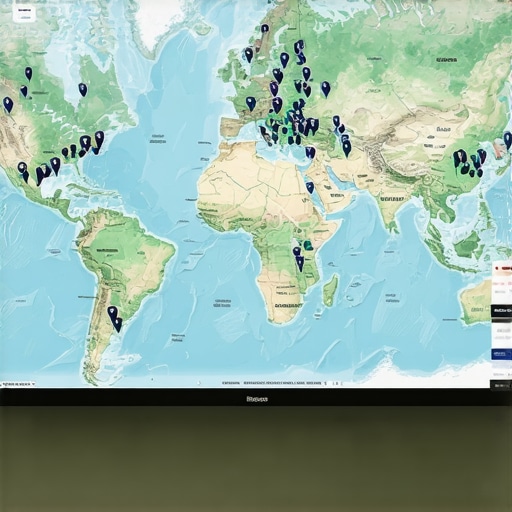
How to scale your map visibility using agency-grade software
I spent three months fighting a hard suspension for a plumbing client whose listing was nuked simply because they shared a suite number with a defunct law firm. Google did not want proof of a van; they wanted proof of a utility bill under the exact GPS pin, showing that a real human was actively running a local business from that coordinate. This is the gritty truth of the proximity layer. The map pack is not a directory; it is a cutthroat, coordinate-based grid where a single digit error in your physical location data can drop your phone leads to zero overnight.
Understanding how the algorithms calculate real-time proximity requires leaving basic assumptions behind. We are dealing with spatial databases that process hundreds of latitude and longitude coordinates per second. If you rely on basic tools, you are flying blind. Scaling your local search footprint requires precision systems designed to audit, clean, and monitor these signals with absolute accuracy.
The math of coordinate salience and map grids
To scale your map visibility with professional applications, you must use grid-based tracking software that maps search positions across a hyper-local geographical mesh. This methodology bypasses the distorted, personalized search results displayed on standard desktop browsers. By measuring local rankings at hundred-yard intervals, agency software reveals exactly where your proximity authority decays. This allows you to deploy targeted optimization campaigns inside those specific, underperforming zones.
Standard trackers are useless for modern local analysis because they query rankings from a single, static point. The real world operates on a coordinate system. A business might rank first at its front door but vanish to tenth place just three blocks away. To understand this volatility, agencies use specialized rank trackers. If you want to dive deeper into these enterprise tools, read the most reliable tools for agency level gmb research which details how professional setups measure genuine geo-specific queries.
When a customer searches for a plumber, their mobile device transmits precise GPS coordinates. Google uses these coordinates to draw an instantaneous proximity boundary. If your business profile has not established strong local relevance signals within that specific boundary, you are filtered out. Enterprise software allows us to run localized scans, showing the exact boundaries where our visibility drops off. We can then target our local content to recover those specific neighborhoods.
“Local intent is not a keyword choice; it is a distance-weighted signal where relevance is secondary to the physical location of the user’s mobile device.” – Map Search Fundamental
The three mile radius that determines your revenue
The geographic boundaries of your search visibility are tightly controlled by the user’s physical distance from your primary centroid location. While traditional optimization focuses on broad city keywords, local algorithms prioritize proximity over almost all other signals. If you cannot establish a dense cluster of local entity associations within a three-mile radius, your digital footprint will fail to expand into profitable adjacent markets.
To expand this radius, your digital presence must establish absolute structural integrity. If your site suffers from indexing issues, your map visibility decays. Fixing internal problems is the first step toward widening your search reach. You can learn how to fix these underlying website issues in technical seo for local businesses fixing broken internal links. Every broken link signals structural neglect to Google crawlers, directly dragging down your overall map authority.
Similarly, broken pathways and redirects destroy the connection between your website and your map profile. When a search spider hits a dead end, it devalues the relationship between your physical address and your web entity. For a step-by-step recovery process, explore how broken redirects are sabotaging your map pack presence. Eliminating these structural bottlenecks ensures your authority flows freely across your entire local digital ecosystem.
The local authority reading list
- Discover the core tools for professional analysis in the specific toolkits we use to audit google business profiles.
- Understand how to inspect your profile with the fast way to audit your business profile using professional toolkits.
- Learn how to handle critical manual actions with what to do when google hits your profile with a manual action.
- Master the recovery steps after a suspension in the exact steps for getting a gmb listing back after a hard suspension.
- Protect your site from malicious attacks with scrubbing malware from your site to restore local trust signals.
The ghost in the GPS coordinates
A business address must represent a physical reality to satisfy the strict anti-spam filters of Google Maps. Using fake addresses or hidden mailboxes triggers automatic suspension filters designed to keep the maps clean. If your location data is inconsistent, search engines will flag your business, causing your profile to disappear from search results entirely until you can verify your true location.
Many business owners fall into the trap of using shared work offices to gain a physical footprint in a new city. This is a fast track to a hard suspension. If you are struggling with a hidden or suspended profile due to shared location issues, read coworking space address issues the fix for hidden gmb profiles. These profiles are flagged because multiple entities are claiming the exact same physical coordinates without having a dedicated, staffed office space.
To fix these issues, we must execute a complete data normalization process. This involves matching every online mention of your business name, address, and phone number to your physical location. You can find detailed guidance on this process in the messy reality of fixing incorrect business addresses online. Eliminating coordinate mismatches is the single fastest way to restore lost visibility and build long-term trust with search engines.
The hidden cost of automated directory submission
Automated submission tools often create duplicate profiles and fragmented citations that dilute your overall local search authority. While clean directories are critical for local authority, messy or duplicate business listings confuse search crawlers and divide your ranking signals. Real success requires a forensic, manual cleanup of your historical citation data across all primary indexers.
Many agencies push cheap citation packages that place your business on low-quality directories, which actually harms your local trust score. To understand why clean citations matter more than volume, see why citation cleanup is more valuable than new link building. Focus on resolving old errors before building new links. Clean data is the foundation of every successful map campaign.
If your business has been around for several years, you likely have old, incorrect NAP data floating around. For a guide on cleaning up this legacy mess, read cleaning up messy citation data for established local brands. Cleaning up these digital footprints removes the conflicting signals that keep your profile stuck in ranking limbo.
“Inconsistent location data across authoritative directories remains the primary reason search engines lose trust in a local entity’s physical coordinates.” – Location Intelligence Research
Why your physical address is a liability
Your physical storefront location can limit your search visibility if you do not actively optimize for service area signals. Brick-and-mortar storefronts are anchored to a single point, but service-based businesses must signal their ability to serve a wider region. If your website does not properly display your service area boundaries, search engines will limit your visibility to a small radius around your physical pin.
If you have suffered a sudden drop in visibility, you need a clear action plan. Find the necessary steps in fix your gmb ranking drop with this recovery action plan. Sudden drops are often caused by Google updating its understanding of physical proximity boundaries or filtering out overlapping profiles in the same category.
When these shifts occur, businesses often realize their local schema is missing or broken. Structured data is what translates your physical address into a language that search engine robots can understand. To fix these critical structured data errors on your website, visit schema errors are confusing google here is how to fix them. Properly structured data ensures your coordinates are correctly indexed by all modern search engines.
The silent filtering of identical categories
Google routinely filters out businesses that share the same category and are located too close to one another. This duplicate filter operates silently, hiding your listing from the map pack even if your profile is active and verified. To escape this filter, your profile must possess stronger authority signals, cleaner review profiles, and more comprehensive local schema than your immediate neighbors.
Understanding this filter is critical for multi-location brands. If you suspect your business is hidden, read escaping the duplicate filter how to get your profile showing again. You must differentiate your brand entity from nearby competitors to ensure search engines display your profile instead of theirs.
To build this authority, your site speed, mobile optimization, and review management must be flawless. Using the right software allows you to monitor these signals across all your locations. To learn more about selecting the right software, check out the software we use to monitor google business profile health. Professional monitoring alerts you the moment a competitor attempts to crowd your primary service radius.