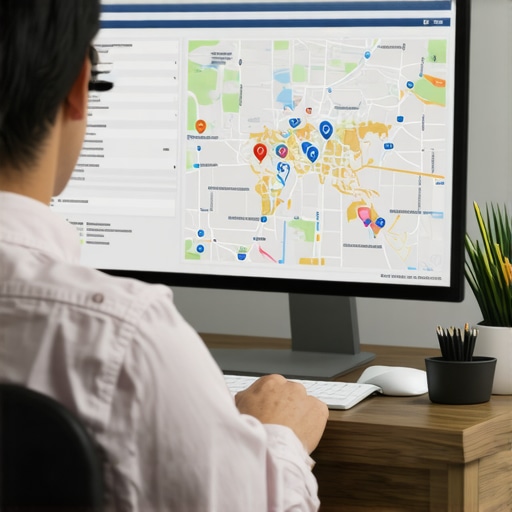
Why Most Profile Optimization Tools Waste Your Time
Profile optimization tools often fail because they focus on superficial data fields instead of physical signals like real customer coordinate paths and local entity verification. Real local search authority is built through hyper-local physical signals, rigorous citation integrity, clean domain structure, and strict adherence to Google Business Profile terms. Relying on basic dashboard metrics won’t save a business from proximity suppression or manual algorithmic penalties.
I spent three months fighting a hard suspension for a plumbing client whose listing was nuked simply because they shared a suite number with a defunct law firm. Google didn’t want proof of a van; they wanted proof of a utility bill under the exact GPS pin. They wanted to see the real physical assets matching the exact latitude and longitude on a physical map. This experience proved that the tools most agencies sell as magic solutions are useless when you face real programmatic actions. If your database records do not match the physical ground truth, your ranking is built on sand.
“Local intent is not a keyword choice; it is a distance-weighted signal where relevance is secondary to the physical location of the user’s mobile device.” – Map Search Fundamentals
The local map pack operates on a physical plane where automated dashboard tools rarely make a difference. These tools often miss the deep structural errors that actually cause listings to disappear from the map view. For example, a business might experience sudden local ranking drops due to bad domain configurations, which can be diagnosed using how broken redirects are sabotaging your map pack presence. When search engines encounter broken paths, they immediately drop the proximity trust score of the associated business profile.
The false promise of dashboard optimization checklists
Most automated tools ignore the deep physical and technical realities of proximity algorithms. They encourage business owners to focus on filling out basic text descriptions and upload generic stock photos. In reality, modern search engines prioritize user-generated geographic data and real-time behavioral signals over static text. This means that a single high-quality photo uploaded by a customer at your business location carries far more weight than fifty optimized posts written on a remote dashboard.
When businesses experience sudden visibility drops, standard optimization tools usually suggest changing keywords or writing more descriptions. They rarely detect hidden technical problems. If your site has suffered security breaches, you may find that why your gmb listing has limited features after a site hack explains why features disappear from your business profile dashboard. When malware compromises a site, search engines restrict profile features to protect users, a critical issue that standard local SEO tools cannot detect or solve.
Furthermore, manual cleanups are much more effective than automated bulk software. If you want to build clean authority, you must understand why citation cleanup is more valuable than new link building. Rather than purchasing cheap link packages, correcting inconsistent address formats across high-authority directories provides the structural stability needed to rank well in competitive search environments.
The hidden technical errors that kill maps visibility
Technical errors on your connected website are the most common cause of sudden local ranking drops. If your website returns server errors or features broken redirect loops, your business profile will lose ranking positions fast. Proximity search engines verify the health of the associated domain to ensure that users are not directed to dead or compromised web pages.
Many agencies attempt to fix these drops by stuffing more keywords into the business name. This dangerous practice often triggers hard algorithmic suspensions. Instead, the first step should be checking your redirect health. To resolve this, you can look into fixing the redirection loops that confuse the map algorithm to restore clean signals to the primary tracking system. Broken pathways confuse crawl bots and signal a poor user experience, leading to lower placement in search results.
Site security is also connected to local maps positioning. Malware infections on a WordPress site will quickly damage local map visibility. Business owners must know how to clean a hacked wordpress site for local seo survival to remove the malicious files that damage their search presence. Clean technical environments are essential for maintaining stable maps performance.
Local Authority Reading List
- Find deep diagnostic tools in the specific toolkits we use to audit google business profiles.
- Understand the cost of bad tactics with the real cost of ignoring gmb keyword stuffing issues.
- Learn manual verification processes via a manual guide to cleaning up messy citation footprints.
- Review emergency recovery strategies in the emergency checklist for sudden gmb visibility loss.
Why automated citation software misses real profile issues
Automated citation aggregators often fail to overwrite outdated or incorrect data across deep search layers. These platforms claim to fix your online presence across hundreds of directory sites instantly. In practice, they create temporary listings that revert to original incorrect data as soon as your subscription ends, leaving you with duplicate entries and inconsistent NAP records.
To fix these issues permanently, you must perform deep, focused cleanups rather than automated blasts. For those managing complex brand profiles, cleaning up duplicate citations for better maps visibility is an essential step to remove conflicting ranking signals. Multiple listings with similar names and phone numbers create internal competition, confusing the search algorithms about which location is genuine.
This is especially true for businesses that have moved or expanded. If your address data is messy, studying the messy reality of fixing incorrect business addresses online will guide you through the process of aligning physical and digital locations. Correcting these records by hand, though slow, creates permanent ranking signals that automated tools can never replicate.
How to rebuild trust after local ranking drops
Restoring lost rankings requires finding the root cause of the drop instead of applying quick optimization tricks. When a listing drops out of the search pack, it is usually because Google’s algorithm has detected a trust violation, such as duplicate schema markups, over-optimized anchor text, or sudden spammy link spikes. Identifying these errors is crucial to restoring organic prominence.
“Consistency of local data is a primary pillar of machine-learned trust; anomalies in location history or structural data will trigger automatic algorithmic suppression.” – Spatial Indexing Journal
First, analyze your structured data files. If you have duplicate code blocks on your home page, you can read about why duplicate schema is sabotaging your map pack ranking to resolve the validation errors. Conflicting schema instructions make it difficult for crawlers to verify your business address and operating hours.
Second, audit your external link profile. Spammy backlink campaigns often trigger manual actions. To correct this, look at fixing toxic links a necessary step for local map rankings to clean up the bad connections pointing to your primary landing pages. Removing toxic backlinks helps rebuild search trust and secures a stable position in local search results.
Tactical solutions for complex penalty cases
Recovering from a severe penalty or suspension requires deep manual audits and direct interaction with support teams. If your listing has been suspended, standard dashboard tools are completely useless. You must gather real-world proof of your business operations and present them clearly to the Google support team.
This is why having a strong audit process is critical. You can use the audit process for finding profile errors in minutes to locate and correct violations before submitting your reinstatement appeal. Ensuring your details are error-free speeds up the recovery process significantly.
If your listing was suspended due to address violations, look into the best way to handle gmb reinstatements for contractors for a step-by-step recovery process. This method helps service area businesses prove their physical presence without violating platform guidelines, ensuring a safe return to the local map pack.