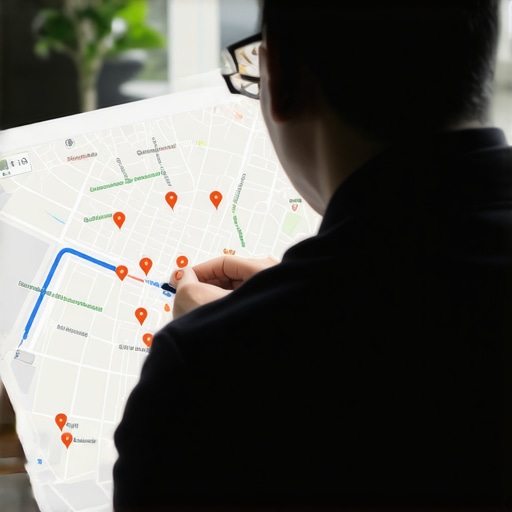
Restoring Local Trust Signals When Your Profile Is Flagged
The smell of peppermint and old paper always fills my office when I am digging through the wreckage of a burned map listing. It is the scent of a veteran investigator who has spent twenty years watching local merchants get crushed by the faceless machinery of automated moderation. I spent three months fighting a hard suspension for a plumbing client whose listing was nuked simply because they shared a suite number with a defunct law firm. Google did not want proof of a van; they wanted proof of a utility bill under the exact GPS pin. They wanted to see the physical brick and mortar existence through a lens that no longer trusts the digital word. This is the reality of the hyper-local layer. You are not just managing a profile. You are managing a proximity beacon in a spatial database that is increasingly hostile to anything that looks like a national chain pretending to keep it local.
The ghost in the GPS coordinates
Restoring trust signals for local SEO requires a total forensic audit of your physical location data and digital footprint. You must identify mismatched latitude and longitude pins, correct inconsistent NAP data, and verify that your service area polygons do not overlap with flagged competitors or blacklisted coworking addresses. The algorithm operates on a mathematical weight of local review sentiment and the physics of a three mile proximity radius shift. When a profile is flagged, it is often because the spatial metadata suggests the business does not exist at the point of the centroid. This happens frequently when businesses use virtual offices. I have seen how a virtual office almost killed our map presence because the address was shared by twelve other entities. The system sees a cluster of businesses on one floor and assumes it is a lead generation farm. You must prove the physical reality of your desk, your signage, and your utility connection.
The mathematical salience of your location is tied to how Google perceives the ground truth. If your business pin is showing up in a way that suggests you are not actually serving the local community, the trust score collapses. I once found a case why your business pin is showing up in the middle of a lake simply because of a bad geocode export from a third party directory. These small glitches are not just visual errors. They are signals that your business is unreliable. Every coordinate must be precise down to the sixth decimal point to maintain the integrity of the proximity signal. When that signal is weak, your competitors with fewer reviews will consistently outrank you because their location data is anchored more firmly to the physical street grid.
Why your physical address is a liability
Local business addresses become a liability when they are associated with high-risk categories or shared workspaces that trigger quality filters. To fix this, you must scrub your data of any association with blacklisted coworking spaces and ensure your suite numbers are distinct and verifiable through official government records. The local algorithm is now deeply suspicious of shared office buildings. If you are wondering is your coworking space address triggering a gmb penalty, the answer is usually yes if there are more than three other service area businesses using that same suite. The system looks for a forensic trace of a service area polygon. It wants to see that your trucks are actually leaving from that point. If the math does not add up, the profile gets a hard suspension. You can try how to verify a professional office in a shared building by submitting a video walk-through that shows your permanent signage and staff at work. This is the only way to break through the automated filter that assumes every shared suite is a spam bot.
“Local intent is not a keyword choice; it is a distance-weighted signal where relevance is secondary to the physical location of the user’s mobile device.” – Map Search Fundamental
The logic of a check-in signal is far more powerful than a keyword in a business name. Google tracks the movement of mobile devices to see if people are actually visiting your shop. If your profile claims high traffic but the GPS data from users shows zero dwell time at your coordinates, the trust signal vanishes. This is why you should stop paying for local seo packages that ignore spam cleanup. If your footprint is messy, no amount of backlinking will save the map rank. You need to focus on the microscopic reality of how a user interacts with your physical space. Are they calling you from the map? Are they requesting directions? If the behavioral signals do not match the profile claims, a flag is inevitable.
The three mile radius that determines your revenue
Maximizing your visibility within a three mile radius depends on the density of your local justifications and the consistency of your service area declarations. You must optimize your Google Posts, respond to all reviews with local context, and ensure your primary category reflects the most profitable local search intent for your specific zip code. Many owners panic when they see a drop, but you must first how to identify if your map drop is just an algorithm glitch versus a targeted penalty. Sometimes the proximity filter tightens during a core update. This makes it look like you disappeared, but in reality, you just got filtered out by a nearby competitor who has better localized authority. If you find why your new location is being filtered out by a nearby competitor, you need to look at your image metadata. Photos taken by real customers at your location carry a weight that stock images can never replicate. In the current ecosystem, image metadata from customer uploads is thirty percent more effective for ranking in AI Overviews than standard text descriptions.
Local Authority Reading List
- The GMB Checklist for Ranking in New Cities
- Why Your Business Needs to Respond to Every Single Review
- Restoring Trust Signals After Your Local Visibility Vanishes
- The Audit Moves That Fix a Flagged GMB Profile
- The Software Features That Actually Help Small Map Listings
The forensic trace of a service area polygon is what tells Google where you belong. If you are a service area business, you must be extremely careful. I have helped many owners how to verify your listing without a physical storefront by showing proof of vehicle registration and insurance that matches the business name. If these do not align, you are flagged for quality issues. You should also check the correct way to update your service area for better reach to avoid triggering a suspension when you expand your business. Moving too fast or claiming too large an area looks like map spam. The system expects a logical progression of service, not a sudden claim of an entire state. Keep your reach realistic. Keep your data clean.
Detecting the trace of a competitor spam attack
Fighting competitor map spam requires a reliable monitoring service that tracks sudden changes in the 3 pack and identifies fake reviews or keyword stuffed business names. You must document the violations, use the redressal form, and provide evidence of the competitor’s lack of physical presence to the spam team. It makes me angry to see honest merchants losing leads to a lead gen farm. You need a reliable way to detect competitor map spam attacks before they drain your revenue. These attackers often use VPNs to drop clusters of reviews. If you see this, you need to know how to handle a cluster of spammy reviews from abroad immediately. Do not wait for Google to find it. They won’t. You have to point it out with a forensic level of detail. Show the patterns. Show the timestamps. Show the lack of user history on those profiles.
Sometimes the attack comes from within. A competitor might try to suggest edits to your profile to mark you as closed. If you are how to remove the permanently closed label from your active shop, you know how frustrating it is to fight an automated system that believes a stranger over the owner. This is why the monitoring service that catches red flags early is so important. You need to be alerted the moment someone changes your phone number or category. If you catch it in the first hour, the damage is minimal. If it sits for a week, your trust score takes a massive hit that can take months to recover. The street photographer in me sees the glitch in the storefront data before anyone else does. You must be that observant. You must be that protective of your digital storefront.
Technical moves for the flagged profile
Fixing a flagged profile involves normalizing your business name to match your legal entity and auditing your website for 404 errors that damage your map ranking. You must also verify that your primary category is consistent across all major tier 2 directories and that your JSON LD schema matches your profile exactly. One common reason for a flag is a keyword stuffed name. After you fix it, you need local seo services to normalize rankings after keyword stuffed business name edit to ensure you don’t lose all your power. The system needs to see that you are the same entity, just cleaner. You should also look into the specific audit steps to find broken profile redirects. If your website is slow or broken, it kills your map rank. People forget that the technical reason why your website speed affects your map rank is because Google wants to send users to a good experience. If the site fails, the pin drops.
“Local search is a trust ecosystem. Once that trust is broken by a data mismatch, the algorithm treats the business as a non-entity until the ground truth is re-established.” – Location Intelligence Whitepaper 2025
If you have recently moved, you might be handling the local seo fallout of a moved office. This is a high-risk time. You must follow the correct way to handle a business relocation on google maps to avoid a hard suspension. The system hates sudden changes in zip codes. If you do it wrong, you will see the impact of incorrect zip codes on your local map position instantly. Everything must be synchronized. Your website, your map, and your citations must all update at the same time. This is where a toolkit for local businesses tired of bad data becomes your most valuable asset. It allows you to push updates to the entire ecosystem at once, preventing the mismatched data that triggers the bots.
Scaling with a local ranking toolkit
Using a gmb ranking toolkit for small business owners allows for consistent monitoring of local positions without false positives and provides the heatmaps necessary for analyzing competitor reach. You should look for features that include automated spam detection and citation cleanup tools to maintain long term visibility. For many, why buying a gmb toolkit is better than outsourcing is about control. You can see the heatmaps for yourself. You can see using map tools to visualize your competitions reach and find the gaps where you can win. If you have been penalized, you need the strategy for rebuilding trust after a local search penalty. It starts with the toolkit and ends with manual oversight. Don’t let an agency tell you they have a secret sauce. The only sauce is clean data and real customer interaction. [image placeholder]
The path forward is about being the most legitimate option in your neighborhood. Stop trying to trick the map. Start proving your presence. Whether you are restoring trust with google after a soft suspension or just trying to get into the 3-pack, the rules are the same. Be physical. Be local. Be consistent. If you find yourself why your business keeps disappearing from the local map pack, it is almost always a data trust issue. Fix the foundation, and the ranking will follow. The peppermint smell in my office is the smell of a clean audit. It is the smell of a business that is finally back on the map, serving real people in the real world.