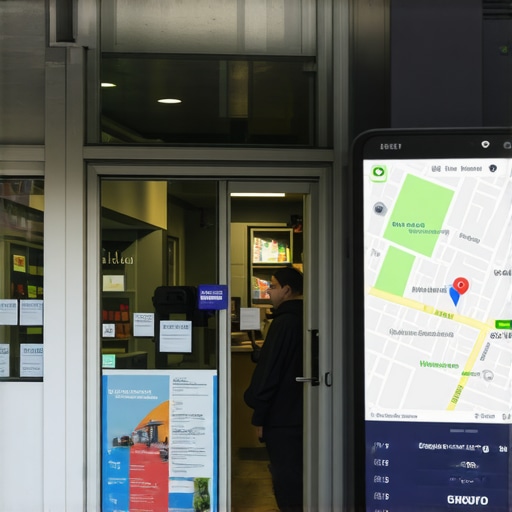
The Fix for Map Pack Loss After a Domain Change
I walk the sidewalks with a manual lens. I notice the neon sign that flickers out of sync with the business hours posted on the glass. I smell the wet concrete after a summer rain. I see the glitch in the data. The storefront is there, but the digital ghost has moved two blocks west. This happens when businesses change their web identity without securing their physical anchor. It is a misalignment of reality and index. I have seen it happen to the best merchants in the city. They update a domain name for a fresh look and then wonder why the phone stops ringing. The digital shadow has been severed from the physical shop.
Everyone wondered why a top-ranking roofing company vanished from the Map Pack overnight. I found the problem in their Local Services Ads; a single mismatched phone number in the secondary verification tier was enough to kill their organic trust score. It was not a site speed issue or a lack of backlinks. It was a failure of identity verification. Google saw two different businesses where there was only one. The engine chose to trust neither. This is the Centroid Collapse. It happens when the mathematical center of your authority shifts because the primary URL signal has been altered. If you do not bridge that gap, the map pin floats away into the void of the fourth page.
The ghost in the GPS coordinates
Google Business Profile rankings rely on a matching URL and physical location signal. When a domain change occurs, the historical proximity data tied to the old URL can disconnect. This creates a ranking gap where the Map Pack visibility drops while the new domain struggles to re-establish local trust signals.
The math behind a local search is uncompromising. Every business exists as a set of coordinates in a spatial database. When you change your domain, you are changing the digital address that Google associates with those coordinates. If the 301 redirects are not perfect, or if the local landing pages are confusing googles bots, the proximity engine loses its grip. It no longer knows if the business at 123 Main Street is the same entity that was there yesterday. It sees a new website and treats it like a stranger. Trust is not inherited automatically. It must be transferred with precision. I have seen rankings fall simply because a business owner forgot to update the website field in their Google Business Profile. The pin moved in the mind of the algorithm even if the bricks stayed put.
Why your physical address is a liability
A physical address acts as a static anchor for local SEO, but it becomes a liability if the NAP data (Name, Address, Phone) is inconsistent. In the wake of a domain change, old citations pointing to a defunct website create data fragmentation that confuses the Map Pack algorithm.
Think of every mention of your business online as a digital footprint. If half of those footprints lead to a dead website, the search engine assumes your business is closed or unreliable. This is why the impact of address inconsistency on your map position is so severe. You must audit every directory. You must scrub the old URL from the web. I spent nights looking through blurry scans of old Yellow Page data to find where a client’s old domain was still cached. The bot sees that conflict. It interprets the conflict as a sign of poor quality. It would rather show a competitor with a consistent profile than a leader with a fragmented one. The street does not lie, and the data should not either.
The three mile radius that determines your revenue
The proximity radius of a Map Pack listing is determined by user location and business relevance. When a domain migration fails to carry over authority signals, the visibility radius shrinks from five miles to less than one, effectively hiding the business from local customers.
Proximity is the strongest signal in the local ecosystem. While agencies talk about backlinks, the algorithm cares about where the user is standing. If you are a plumber, you want to be visible to someone with a leaking pipe three blocks away. But if your domain change caused a drop in authority, your visibility radius will collapse. You might still show up if someone stands in your parking lot, but you disappear once they drive a mile away. You can use tools that reveal the real proximity of your competitors to see this shrinking in real time. It is a silent killer of revenue. You think you are still ranking because you see yourself when you search from the office. You do not realize you are invisible to the rest of the neighborhood. This is why why proximity matters more than domain authority in maps is a vital lesson for every merchant.
“Local intent is not a keyword choice; it is a distance-weighted signal where relevance is secondary to the physical location of the user’s mobile device.” – Map Search Fundamental
Local Authority Reading List
- How to handle a map pack drop after a site migration
- The software stack that actually helps you rank
- Why your map rank is low while your seo looks great
- The manual way to fix citations that bots miss
- How to audit your gmb profile for hidden ranking errors
- The difference between organic seo and map pack recovery
- Why most gmb tracking tools give you wrong data
Broken bridges between the URL and the map pin
A domain change often breaks the schema markup links that connect a website to a Google Business Profile. To fix this, you must update LocalBusiness JSON-LD with the new URL and ensure that 301 redirects correctly point all legacy location pages to their new equivalents.
I have looked at thousands of lines of code where the business name is correct, but the URL is still pointing to a 404 page. The bot crawls the site, hits a wall, and stops. It cannot verify that you are the same entity. This is why how to handle a map pack drop after a site migration requires a deep look at your technical infrastructure. You need to verify that your Open Graph tags and your Twitter cards also reflect the new domain. Every social signal must be aligned. If the bot sees a Facebook page linked to the old domain and a GMB profile linked to the new one, it creates a conflict. The map pack is a game of certainty. The more certain Google is about who you are and where you are, the higher you rank. When you change domains, you introduce doubt. You must work twice as hard to remove that doubt. This involves the manual process for fixing citation data conflicts instead of relying on automated tools that often miss the nuances of local data.
The high price of mismatched phone numbers
Phone number consistency is a top three ranking signal for the Google Map Pack. If a domain change is accompanied by a tracking number update without proper NAP synchronization, Google will likely demote the listing due to identity mismatch.
I remember a cafe that changed their name and their website. They also got a new phone number. Within a week, they went from first to nowhere. They thought it was the website. It was actually the phone number. The old number was still all over Yelp and TripAdvisor. Google saw the old number and the old name as one entity and the new ones as a different, unproven entity. They were competing against their own ghost. You must use a how to audit your gmb profile for hidden ranking errors strategy to find these discrepancies. Do not let your old data haunt your new brand. This is a common trap. People think they can just start over. You never start over in local search. You only build on what was there before. If you don’t clean up the mess, the mess will bury you. I see it in the storefronts every day; the old paint peeling away to reveal the previous owner’s name. The digital world is the same. The old name is still there, beneath the surface, confusing the customers and the bots.
“Local search behavior is increasingly focused on immediate fulfillment, where the distance to the provider is the primary filter for 80 percent of mobile queries.” – Location Intelligence Report
Rebuilding a clean local profile from the ground up
To recover map rankings, you must perform a manual citation audit and verify that the primary category in your Google Business Profile matches the keywords on your new landing pages. This synchronization is the fastest way to regain trust and visibility in the local 3-pack.
It takes patience. You cannot rush the index. You have to wait for the spiders to crawl the new pages and see the updated schema. You have to wait for the directory sites to accept your manual changes. But it works. I have watched businesses climb back up the ladder one rung at a time. They start by rebuilding a clean local profile from the ground up. They don’t take shortcuts. They don’t buy fake reviews. They focus on the reality of their location. They take new photos of their storefront. I always tell my clients to take candid photos. The algorithm is getting better at recognizing stock photography. A real photo of your sign, taken from the street with a mobile phone, carries more weight than a professional studio shot. It contains GPS metadata. It proves you are where you say you are. That is the kind of evidence that wins a reinstatement war or a ranking battle. The street has a rhythm. Your data must match that rhythm. If it does not, you are just noise in the system. And the system is very good at filtering out noise. Use a a lean toolkit for winning the google maps 3-pack to monitor your progress. Watch the heat maps. See the green circles expand as you fix each broken bridge. The goal is to be the obvious choice for the search engine. When the domain, the address, and the phone number all sing the same note, the Map Pack will welcome you back.