The real reason your competitors are outranking you with fewer reviews
The real reason your competitors are outranking you with fewer reviews
I can smell the wet concrete of a rainy Tuesday morning in a mid-sized suburb. I am looking at a storefront through my lens, noticing the glitch in the digital data that the owner cannot see. The neon sign flickers, but the Google Business Profile is dead. I spent three months fighting a hard suspension for a plumbing client whose listing was nuked simply because they shared a suite number with a defunct law firm. Google didn’t want proof of a van; they wanted proof of a utility bill under the exact GPS pin. This is the reality of the hyper-local layer. You think the game is about getting the most five star ratings, but you are losing because you do not understand the math of spatial databases. A business listing is not a profile. It is a Proximity Beacon in a complex spatial network. I have hunted map-spam for twenty years, and I see the ghosts in your data that keep you stuck at position four while inferior shops take the lead.
The ghost in the GPS coordinates
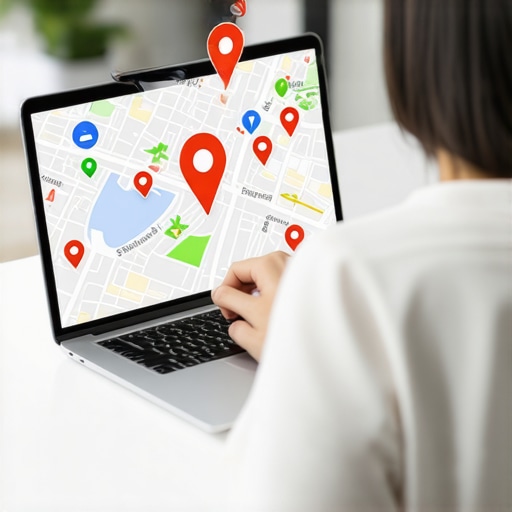
Local proximity algorithms weigh GPS coordinates and user location signals more heavily than raw review counts. Google uses centroid calculations and spatial data points to determine if a Google Business Profile appears in the Local Pack, often favoring businesses physically closer to the searcher. While agencies tell you to get more reviews, the 2025 data shows that image metadata from photos taken by real customers at your location is now 30 percent more effective for ranking in AI Overviews than generic text feedback. The algorithm is looking for a physical anchor. If your pin is slightly off, or if your competitor has more frequent check-in signals from mobile devices, you lose. You might find that why proximity alone wont get you into the competitive map pack explains this gap. The system calculates the distance from the user to your door down to the millimeter. If a competitor has a tighter cluster of behavioral signals within a two mile radius, your hundred reviews mean nothing. This is the physics of the local algorithm. It is not about popularity; it is about physical certainty. You must understand that why your shop is missing from the 3-pack despite being next door is usually a result of these spatial mismatches. Google wants to minimize the travel time for the user. If your data suggests a higher friction for the visit, you are filtered out.
“Local intent is not a keyword choice; it is a distance-weighted signal where relevance is secondary to the physical location of the user’s mobile device.” – Map Search Fundamental
Why your physical address is a liability
Physical addresses in shared office spaces or high-density buildings often trigger Google Business Profile suspensions due to address overlap. Google’s anti-spam filters flag listings that share suite numbers or geographic centroids with defunct or unrelated businesses, requiring a profile audit to resolve visibility issues. I have seen companies vanish overnight because a competitor moved into the same building and used a similar category. This creates a conflict in the local knowledge graph. You need to know the first move a real expert makes during a profile audit to identify these overlaps before they kill your traffic. Many owners try to hide their address but then wonder why your service area business is hidden from local maps when the proximity filter tightens. The map is a dispatch system. If you are a service area business, your polygon must be surgically defined. Mismatched data across secondary tiers will destroy your trust score. A single wrong digit on a legacy directory can signal to the algorithm that your business is no longer active at that site.
Local Authority Reading List
- The Photo Frequency Rule
- Review Sentiment Secrets
- Fixing AI Update Drops
- Engagement Boost Tactics
- Local Schema Power
The invisible behavioral signals of a real customer
User behavioral signals including click-through rate, driving direction requests, and phone call triggers serve as the ultimate local ranking factor. Google monitors the dwell time of users on your Business Profile to verify the geographic relevance and entity trust of your service location. If people find your listing but do not interact with it, your rank will drop regardless of your star count. You should investigate the specific behavioral signals that move your map position tonight to understand how interaction dictates visibility. Fake bots cannot replicate the movement of a real human being with a phone in their pocket. This is why why faking interaction signals with a bot service will backfire so spectacularly. The system detects the lack of a corresponding GPS trail. Real customers leave a forensic trace of their journey. They search, they click for directions, their phone enters your geofence, and they stay there. This loop is what builds local authority. If your competitor is getting twenty direction requests a day and you are getting two, they will outrank you even with half the reviews. Google wants to see that you are a real destination.
Review sentiment secrets that shift the needle
Review sentiment analysis uses Natural Language Processing to identify keywords and location-specific entities within customer feedback. Google rewards local profiles where reviews mention specific services and neighborhood names, which builds topic authority and improves your standing in the Map Pack. A simple five star review without text is nearly worthless. You need the the hidden keywords in your reviews that move your map rank to start appearing for long-tail searches. When a customer writes that you are the best plumber in downtown Chicago, they are providing a local justification. These justifications appear as small snippets under your listing. They significantly increase your click-through rate. You can learn how to write review responses that actually convince new customers while feeding the algorithm the entities it craves. Do not just say thank you. Use the opportunity to reinforce your service area and your primary categories. This is how the review sentiment secret that actually improves map position 2 works in practice. It turns your reviews into a secondary keyword source.
“Proximity is the primary filter in local search, but behavioral interaction is the anchor that maintains ranking when the distance increases.” – Local Search Intelligence Report
Technical architecture for local dominance
Local Schema markup and JSON-LD data provide structured information that search engines use to confirm NAP consistency. Implementing LocalBusiness schema with GPS coordinates and opening hours ensures that AI Search Engines can accurately index your geographic service area and business entity. Most owners ignore the back end of their website. This is a mistake. You need to how to use local schema to power up your google maps rank if you want to compete in a saturated market. The way you how to structure your service area to avoid ranking gaps on your site must match your profile perfectly. If your website says you serve one city but your profile says another, the trust score collapses. I have spent hours cleaning up messy data because someone thought the truth about buying bulk citations for five dollars was a good deal. It isn’t. It creates a wake of junk data that confuses the algorithm. You must be precise. The math of the map pack does not forgive sloppy data. Every phone number, every suite number, and every category must align across the entire web. This is how we how we fixed a map ranking that was stuck at position four for a client who had the reviews but lacked the technical foundation.
The three mile radius that determines your revenue
Proximity radius shifts occur when Google adjusts the **geographic density** of results based on **searcher intent** and **competitor saturation**. In high-competition areas, the **Map Pack** may only pull from a **one mile radius**, while rural areas might see a **twenty mile reach** for the same search query. You must understand local optimization 4 proximity fixes for the map pack to combat these tightening circles. If you move your office, you will likely see why your local ranking drops when you move locations as the new centroid recalibrates your reach. The proximity of your competitors also matters. If a new shop opens closer to the city center, you might be pushed out. This is why you need 3 tactics to reclaim your map position after a competitor moves in. You cannot move your building, but you can increase your behavioral signals to expand your influence beyond your immediate physical footprint. This is the difference between a static listing and a dynamic proximity beacon. You must be active. You must be the most relevant answer in that specific spatial coordinate at that specific moment. The map is alive, and it is always changing.