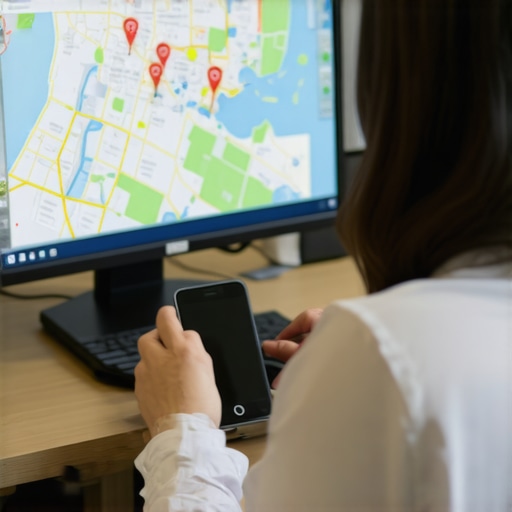
Why your GMB reviews aren’t showing up on the map
The sidewalk outside the storefront smells like wet concrete and exhaust. I spent years wandering these streets with a camera, capturing the physical reality of businesses before they were digitized into pins on a map. You see a profile; I see a spatial glitch. Most business owners think a review is a simple text entry. They assume that if a customer hits the submit button, the review exists. It does not. Not until the algorithm validates the forensic signature of that interaction. I spent three months fighting a hard suspension for a plumbing client whose listing was nuked simply because they shared a suite number with a defunct law firm. Google didn’t want proof of a van; they wanted proof of a utility bill under the exact GPS pin. That level of scrutiny is exactly why your reviews are disappearing. The system is no longer looking for words. It is looking for proximity, behavioral patterns, and the mathematical weight of local relevance.
The invisible filter blocking your customers
Google Business Profile reviews often vanish because of IP address discrepancies, review velocity spikes, or non-local user profiles. When a customer stands in your lobby and connects to your guest Wi-Fi to leave a review, the system flags it. It sees the same IP address for both the business and the reviewer. This triggers a fraud filter. You think you are being helpful by offering internet access. In reality, you are sabotaging your own reputation. The algorithm prefers a messy, organic signal. It wants to see the mobile data pinging off a cell tower half a mile away while the user’s GPS shows they spent twenty minutes at your coordinates. If you want to understand the mechanical reason for these disappearances, you need to know that the review filter is real and functions as a gatekeeper for your local trust score. The system is designed to be suspicious. It treats every new piece of data as a potential lie until proven otherwise.
Why your physical address is a liability
Inconsistent opening hours and NAP data conflicts signal a lack of local business reliability to the algorithm. If your hours on Yelp don’t match your hours on your storefront photo, the system creates a trust deficit. This is where the citation cleanup process becomes the only way to restore your standing. I have seen listings suppressed for years because an old office address from 2018 was still floating around on a dusty directory site. The algorithm cross-references everything. It looks at your electricity bill, your secretary of state filings, and your social media footers. When it finds a mismatch, it doesn’t just lower your rank. It stops trusting the new reviews coming in. It assumes the business is volatile or unverified. If you are struggling with a GMB listing suspension, the root cause is almost always a data mismatch that you ignored six months ago.
“Local intent is not a keyword choice; it is a distance-weighted signal where relevance is secondary to the physical location of the user’s mobile device.” – Map Search Fundamental
The three mile radius that determines your revenue
Proximity signals dictate that user location is the most powerful ranking factor in the Map Pack algorithm. You cannot rank in a city thirty miles away just by typing the city name in your description. That is 2015 logic. Today, the algorithm uses a hyper-local centroid. If a user is searching from a street corner two miles away, you might be number one. If they move three blocks further, you might vanish. This is why failing the proximity test is the most common reason for a sudden drop in calls. The system is zooming in. It cares about the walking distance. It cares about the traffic patterns. It even looks at the density of competitors in that specific micro-polygon. If you want to expand your reach, you don’t need more keywords. You need more behavioral signals from those distant areas. This involves getting customers from those specific zip codes to interact with your pin. Without that localized interaction, your profile remains a ghost outside of your immediate block.
The toxic sludge in your link profile
Spammy backlinks and irrelevant directory links create a trust deficit that prevents your profile from appearing in the top three results. Many agencies still sell packages that blast your URL to thousands of low-quality sites. This is a mistake. The map algorithm is smarter than the general search algorithm. It knows that a local plumber shouldn’t have five hundred links from a Russian tech blog. You need local backlinks that improve map position by proving you are a part of the local community. Think of links from the local Little League, the neighborhood chamber of commerce, or a nearby hardware store. These are the signals that prove your physical existence. When you clean up spammy backlinks, you aren’t just removing junk. You are clearing the path for Google to finally trust your review count again. A profile choked by spam will never display its full review history.
Detecting the competitor map spam attack
Competitor gmb spam attacks involve suggested edits, fake negative reviews, and location keyword stuffing to push legitimate businesses off the map. I have watched good men lose their livelihoods because a competitor hired a bot farm to report their business as “permanently closed” every Friday night. You need services to detect and fight competitor spam if you want to survive in high-competition niches. The algorithm is often reactive rather than proactive. It takes the word of a “Local Guide” over the business owner. If you see your reviews disappearing, check if your competitors are suddenly surging with generic five-star praise. They might be triggering a filter that catches you in the crossfire. You must monitor your profile daily. Look for the glitches. Look for the strange edits to your service area. If you don’t defend your digital territory, someone else will claim it.
The gmb ranking toolkit that actually works
A GMB ranking toolkit must include grid tracking, local search audit functions, and sentiment analysis to provide an accurate visibility report. Most business owners are looking at their rankings from their own office. This is a biased view. Google knows where you are. It shows you what you want to see. To get the truth, you have to verify your rank without personalized search bias. You need to see the map through the eyes of a stranger five miles away. This requires professional software that can simulate searches from different GPS coordinates. If you buy local seo tools for gmb, ensure they offer a heat map of your rankings. A single number like “Ranked #2” is useless. You need to know exactly where that rank starts and where it ends. The edges of your visibility are where the real work begins.
Local Authority Reading List
- Strategic Review Acquisition
- The 3-Pack Technical Checklist
- The Invisible Business Syndrome
- Software Audit Protocols
- ROI Focused Map Packages
The red banner of administrative death
A partial suspension with limited gmb features typically results from suspicious activity or violation of the name guidelines. If you added keywords like “Best Plumber” to your business name, you are begging for a manual review. When the red banner appears, your reviews are the first thing to go. They won’t vanish from the backend, but the public will never see them. Recovering from this requires a surgical approach. You have to fix a partial suspension by reverting every single change you made in the last thirty days. Then, you provide the evidence. Not a photo of a business card, but a high-resolution video of you walking into the office, showing the signage, and opening the mail. The algorithm is a gatekeeper that demands absolute physical proof. If you cannot provide it, the filter stays on.
“Relevance is determined by the thematic alignment of the business category and the user query, but trust is earned through the consistency of the NAP data across the entire web.” – Spatial Intelligence Report
The forensic math of review sentiment
Review sentiment is now a primary ranking signal that outweighs simple star ratings in the modern local search algorithm. Google is reading the words. It is looking for specific nouns. If you are a dentist and your reviews mention “painless,” “root canal,” and “professional,” you are building topical authority. If they just say “great service,” the algorithm gives it almost zero weight. This is why review sentiment score matters more than having a perfect 5.0. In fact, a perfect 5.0 is often seen as a spam signal. Real businesses have mistakes. Real customers have complaints. The algorithm wants to see a 4.8 with detailed, descriptive text. If your reviews aren’t showing up, it might be because they are too short or too generic. The system thinks they were written by a bot. Encourage your customers to describe the specific service they received. That metadata is the fuel for your Map Pack position.